
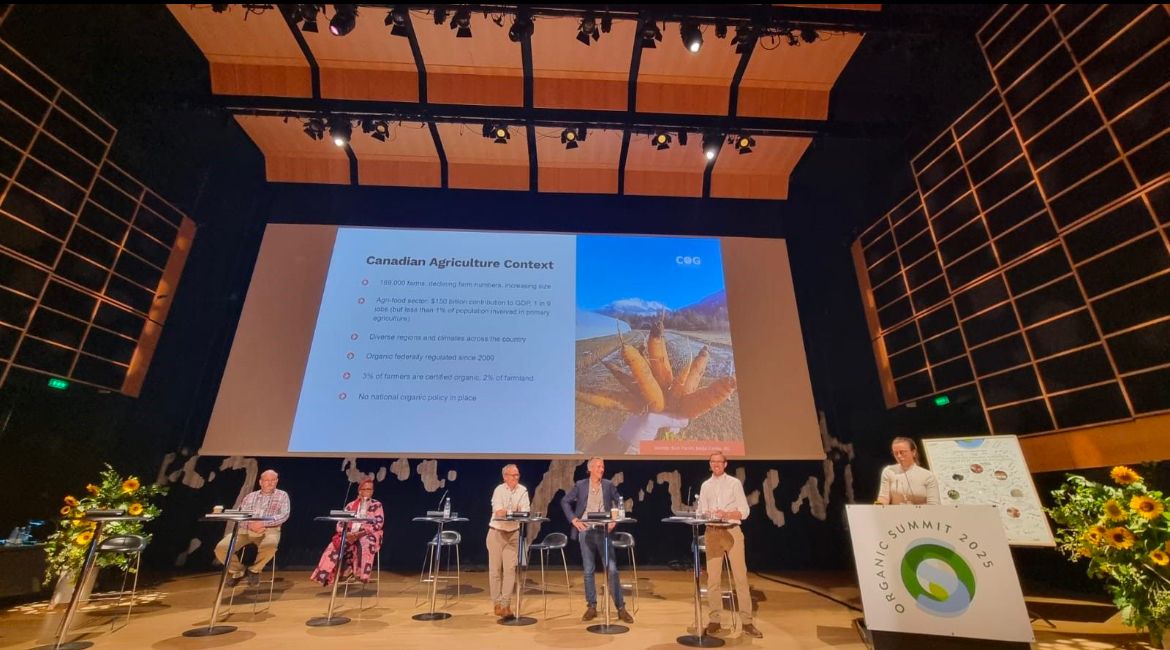
From August 18th-22nd 2025, Canadian Organic Growers’ Director of Policy and Research, Katie Fettes, traveled to Copenhagen, Denmark with Eva-Lena Lang, Executive Director of Organic BC, and Gillian Flies, Executive Director of the New Farm Centre, to attend the Organic Summit.
Hosted in Denmark during its Presidency of the Council of the European Union, the Summit was co-hosted by a wide range of Danish stakeholders including Organic Denmark in close cooperation with the Danish Government. It brought together policymakers, farmers, businesses, researchers, and organic leaders from around the world to share strategies for expanding organic farming, growing markets, and advancing food system sustainability.
Denmark is widely recognized as a global leader in organic food and farming. More than 98% of Danes recognize the Danish Organic label, and 65.5% purchase organic weekly. The Summit provided an opportunity to learn directly about the policies and partnerships that have helped Denmark build one of the world’s strongest organic production sectors and markets, including the country’s goal of reaching 25% organic farmland by 2030 as part of broader EU targets.
Summit sessions highlighted the Danish model, including strong public policy, retail engagement, and partnerships including collaboration among farm organizations. Successful levers in Denmark offer ideas for Canada, including:
- A dedicated organic law and coordinated, long-term strategy that includes policy (successive Organic Action Plans since 1995 with clear growth goals), markets, and sector organizations
- 60% nationwide organic public procurement targets, with some municipalities aiming higher, e.g. 90% organic public procurement target in Copenhagen, achieved within the same budgets by training public sector kitchen staff on menu planning, sourcing seasonal ingredients, and reducing food waste
- Free organic “farm checks” for farmers to work with an advisor to explore what organic transition could look like on their farm, led by the Innovation Centre for Organic Farming, a collaboration between Organic Denmark and the Danish Agriculture and Food Council, a dedicated institution focusing on applied research, innovation, and extension
- Organic certification at no cost to the farmer
- Conversion payments for farmers during the conversion period to organic production, along with ongoing incentives for organic land maintenance
- Retail and consumer engagement strategies to make organic products accessible and affordable, while ensuring the red “Ø-label” is highly recognized and trusted; along with the launching of a tiered organic cuisine label
- A balance of push policies (upscaling organics in farming) and pull policies (market and supply chain development)
- Recognizing and incorporating organic food and farming as a tool within broader public priorities and policies, including for climate action, biodiversity, public health, clean water, food security, export promotion, rural development, and plant-based transition
Katie also spoke in the session on “National & Regional Policies Upscaling Organic Farming and Markets”, sharing recent work on evidence-based policy development and coalition-building through the Canadian Organic Alliance, alongside speakers from Tanzania, Denmark, The Netherlands and Scotland.
Throughout the Summit, participants explored how the organic movement is evolving, including alignment with regenerative, agroecological and food sovereignty approaches, and new work on measuring outcomes and impacts by the Sustainable Food Trust, IFOAM Organics Europe and others. There was also discussion on Denmark’s new Green Tripartite Agreement – a historic agreement among government, farmers, and conservation to align land use, nature restoration, and food production.
While in Denmark, the Canadian delegation also visited a multigenerational mixed organic farm, a retailer with a growing commitment to organics (MENY Danmark), Northern Europe’s largest vocational college for the hospitality industry advancing organic and sustainable gastronomy (Hotel Og Restaurantskolen), and a public kitchen preparing 6,000 fresh school meals daily with 90% organic ingredients under Copenhagen’s 90% organic public procurement policy (EAT Copenhagen).
As Denmark’s Finance Minister Nicolai Wammen said in closing the Organic Summit: “We recognize organic as more than a production method – it’s about delivering for the public good. The world needs more organic!”
The Summit showed what is possible when governments, farmers, businesses, and citizens work together with a long-term vision. Canada has significant potential to grow organic production and markets as part of a resilient, competitive, and regenerative food system. Thanks Denmark for the inspiration and hospitality!