
Learning Journey: Macro-Life
Worms, beetles, ants, and spiders are only a few examples of macro-life that play unique roles in the soil food web and build soil health and structure. Unlike micro-life, which requires a microscope to observe, macro-life can be seen by the naked eye without magnification and is essential to a functioning soil ecosystem. Like any ecosystem, soil depends on a complex food web made up of interconnected producers and consumers. These relationships create a dynamic balance of energy and life, supporting a resilient and thriving environment. Macro-life species help form intricate tunnels in the soil, which enhance aeration, improve water infiltration, and promote nutrient cycling. As primary and secondary consumers, they feed on lower-level organisms and contribute to nutrient availability through digestion and waste. The presence and activity of macro-life are crucial to maintaining soil health and growing strong, productive crops.
This learning journey is a curated collection of educational resources, designed to help you explore soil macro-life. To use this learning journey to its full benefit, please follow along via the steps detailed below.
What Is Soil?
Soil is a complex, living ecosystem that supports plant growth, regulates environmental processes, and sustains agricultural production. It is home to an immense diversity of organisms that influence soil structure, fertility, and resilience.
Types of Soil Organisms
The organisms involved in the soil food web can be categorized into two primary groups:
Micro-organisms: Tiny life forms, like bacteria, fungi, and protozoa, that cannot be seen with the naked eye.
Macro-organisms: Larger organisms, such as earthworms, insects, and small mammals, that are visible.
Diagram of the Soil Food Web
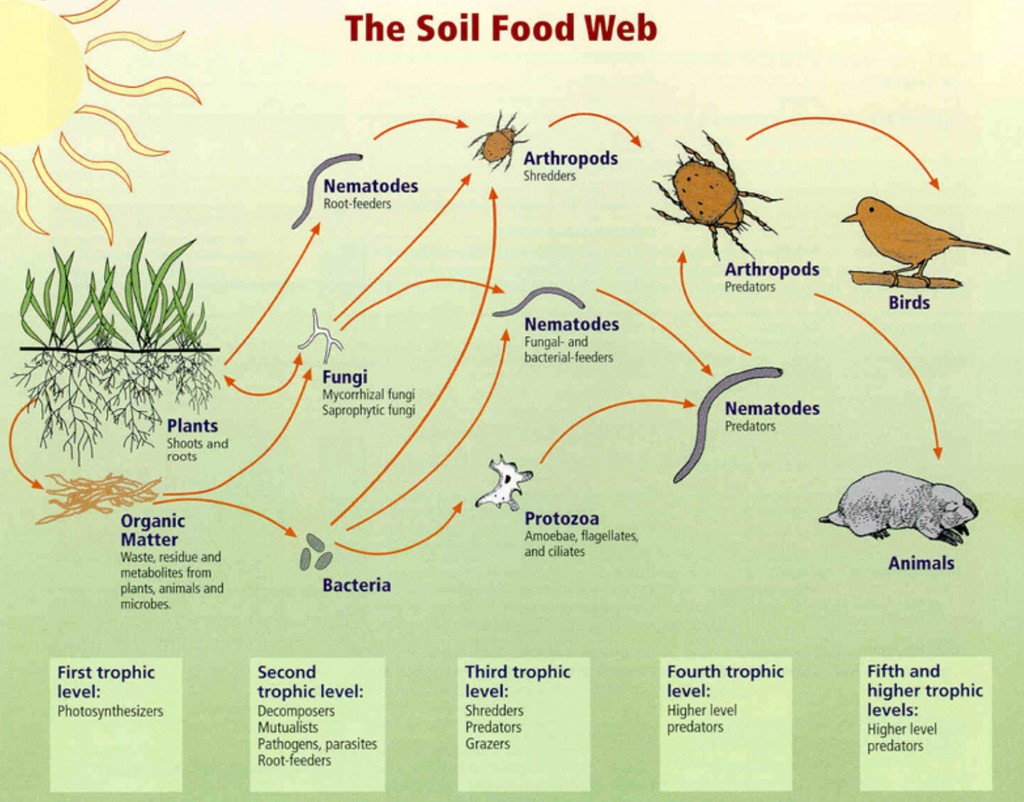
The soil food web describes how energy and nutrients flow through soil ecosystems. It consists of several interconnected levels:
- Primary producers
- Primary consumers
- Secondary consumers
- Higher-level consumers
Primary Producers: The Photosynthesizers
The foundation of the soil food web begins with the first trophic level, consisting of photosynthesizers (i.e., plants) and organic matter. Plants play a crucial role in capturing carbon from the atmosphere and converting sunlight into energy through photosynthesis. This process produces oxygen and sugars, which fuel plant growth and development.
However, plants require more than just energy from photosynthesis to thrive. They also need essential nutrients such as nitrogen, phosphorus, and potassium, which cannot be produced through photosynthesis. This is where soil microorganisms and their ability to recycle organic matter into plant available nutrients come into play.
Primary Consumers: The Consumers of Plants
Bacteria and fungi are essential components of the soil food web. They break down organic matter — such as dead organisms, plant materials (i.e., leaves, chaff, etc.), and animal wastes. They transform the nutrients contained in their food source into forms that plants can absorb.
As organic matter is decomposed by the soil food web, essential elements like carbon, oxygen, nitrogen, and phosphorus are released into the soil. However, these nutrients are not immediately available to plants. Bacteria and fungi consume these nutrients, which are effectively stored within their bodies. When these microorganisms are themselves consumed by other organisms — such as protozoa, nematodes, and arthropods — the excess nutrients that these predators do not need are excreted back into the soil in a plant-available form. This process, known as nutrient mineralization, is a key step in the natural cycling of nutrients.
Secondary Consumers: Predators
Predators consume other organisms to gain nutrients. These include nematodes and protozoa (such as flagellates, amoebae, and ciliates). Their primary role is nutrient mineralization, which occurs as they consume bacteria and fungi, breaking them down and releasing essential nutrients into the soil in plant-available forms. Like all predators, their feeding behaviors also help to regulate the populations of their prey (i.e., bacteria and fungi) ensuring the ecosystem remains in balance.
Higher-Level Consumers: Level Four
The soil food web consists of higher-level consumers that help regulate populations and maintain ecosystem balance. The fourth trophic level includes earthworms, macro-arthropods like beetles and centipedes, and omnivorous nematodes, which feed on secondary consumers such as predatory nematodes and protozoa. These organisms also contribute to nutrient cycling and improve soil structure by breaking down organic matter.
Higher-Level Consumers: Level Five
The fifth trophic level consists of top predators, including larger predatory arthropods and certain nematodes, which help control other predator populations and prevent imbalances in the food web. Larger burrowing animals, such as rodents and birds, also interact with the soil ecosystem by modifying soil structure, redistributing organic matter, and influencing macro-organism populations.
To download the content above in a presentation PDF, please click the button below:
To download the content above in a printable format, please click the button below:
Soil organisms can be categorized based on their ecological functions:
- Decomposers: Bacteria and Fungi
- Nutrient Cyclers: Protozoa and Nematodes
- Multitaskers: Arthropods
- Engineers: Earthworms and Other Burrowers
Decomposers: Bacteria
Bacteria and fungi are the powerhouses of decomposition, breaking down organic matter and cycling nutrients back into the soil. Bacteria handle the simpler stuff, mineralizing nutrients and making them available for plants. Some bacteria, like nitrogen-fixers, pull nitrogen from the air and convert it into a form plants can use. Others help plants directly by forming symbiotic relationships or producing antibiotics that suppress harmful microbes.
Decomposers: Fungi
Fungi, on the other hand, specialize in the tough jobs —breaking down complex materials like lignin and cellulose (tough or woody plant materials). Their hyphal networks physically bind soil particles together and improve soil structure. Mycorrhizal fungi go a step further, acting as an extension of a plant’s root system and producing glomalin, a sticky protein that helps hold the soil together. Some fungi also act as natural defenders, outcompeting or directly attacking plant pathogens.
Nutrient Cyclers: Protozoa & Nematodes
Protozoa and nematodes are grazers in the soil food web, feeding on bacteria and fungi and releasing excess nutrients in plant-available forms. Protozoa and nematodes play a key role in making nutrients accessible to plants. Their grazing stimulates microbial activity, aids in organic matter breakdown, and helps build soil structure.
Multitaskers: Arthropods
Arthropods include insects and all the hard-bodied creatures that inhabit the soil. They are multitaskers, taking on a variety of roles in the soil food web. They act as: Shredders, Predators, and Burrowers
Shredders (i.e. millipedes, sowbugs, termites) break down dead plant material, making it easier for microbes to decompose. Predators (i.e. centipedes, spiders, ground beetles) help control pest populations, preventing outbreaks that could harm plant life. Burrowing insects improve soil aeration, water movement, and soil structure while their feeding activities break down bacteria and fungi, thereby cycling nutrients into plant-available forms. Even their waste plays a role by helping bind soil particles together and improve overall soil aggregation.
Engineers: Earthworms & Other Burrowers
Burrowing organisms are natural engineers, constantly reshaping soil structure and improving its function. As they dig, they create tunnels that improve air circulation, water infiltration, and root growth while reducing soil compaction. By feeding on organic matter, they help break down plant debris, accelerate decomposition and make nutrients more accessible to microbes and plants. Their waste (AKA worm castings) binds soil particles together, strengthening aggregate stability and reinforcing the structure they help create.
This Information has been adapted from Dr. Elaine Ingham’s The Soil Food Web Essentials Course
To download the content above in a presentation PDF, please click the button below:
To download the content above in a printable format, please click the button below:
Generalists and Specialists
Soils are filled with microorganisms that are incredibly small but exist in vast numbers, allowing them to move easily and adapt to different environments. Microbes, like all other organisms, have different strategies for surviving change. Some are generalists while others are specialists:
Specialists thrive in specific conditions and have narrow ecological roles. They often rely on particular food sources or environmental factors.
Generalists are highly adaptable and can survive in a wide range of soil conditions. They play flexible roles in the ecosystem, consuming various food sources and adjusting to environmental changes.
Ecological Succession
Generalists, capable of thriving in a wide range of environmental conditions, often dominate in the early stages of succession, rapidly colonizing disturbed or new environments. As conditions stabilize, specialists (organisms adapted to specific niches) become more prominant, optimizing soil functions through intricate interactions within the ecosystem. This dynamic interplay between generalists and specialists ensures a continuous process of ecological succession, leading to the development of diverse and resilient soil ecosystems.
Ecosystem Services Provided by Soil Organisms
Ecosystem functions supported by micro- and macro-life in the soil include:
- Regulating Services
- Supporting Services
- Provisioning Services
Ecosystem Services: Regulation
- Climate regulation: sequesters carbon, stabilizes greenhouse gases.
- Water regulation and purification: filters pollutants, improves moisture retention.
- Disease and pest control: suppresses pathogens, limits invasive species.
- Decomposition and nutrient cycling: breaks down organic material, supporting nutrient cycling.
Ecosystem Services: Support
- Building and stabilizing soil: contributes to soil structure, improving stability and resistance to erosion.
- Nutrient cycling: breaks down dead plant material and releases nutrients in a form that plants can absorb.
- Water cycling: affects how soil absorbs and retains water, influencing both local and global water cycles.
- Supporting plant growth: enhances soil health, promotes root development, and improves nutrient availability for plants.
- Maintaining biodiversity: helps sustain a diverse soil ecosystem, supporting plant and microbial interactions.
Ecosystem Services: Provisioning
- Production of crops: maintains soil conditions that support the growth of plants for food, fiber, and other agricultural uses.
- Bioremediation agents: contribute to soil detoxification and restoration by breaking down pollutants and improving soil health.
This information was adapted from Sacca et al. 2017.
To download the content above in a presentation PDF, please click the button below:
To download the content above in a printable format, please click the button below:
It Takes a Village: Uniting Ecological Networks for Collective Support
Community dynamics, in ecological process terms, encompass the interactions and relationships among diverse organisms within an ecosystem, shaping its structure, function, and resilience. Community dynamics, or diversity, captures the essence of the saying, “It takes a village to raise an ecosystem,” emphasizing the teamwork needed for supporting the well-being of an ecosystem. As plants, animals, insects, and microorganisms interact and change over time, they create a web of connections that support the health and resilience of the ecosystem.
This interconnectedness acts like a safety net, helping ecosystems stay strong against diseases and other environmental pressures (bad weather), while also building up positive effects over time. By nurturing a variety of plants—from grasses and flowers to trees and annual species—we keep the flow of nutrients and energy running smoothly, which in turn helps to maintain a rich array of life.
Community dynamics describes the continual changes in ecological communities. Alterations in one part of the ecosystem cascade through all others. Moreover, it emphasizes the importance of having plants, animals, fungi, and microorganisms at all developmental stages, as this balance between growth and decay is crucial for maintaining a healthy ecosystem.
Observation is Key
Observation is crucial for understanding your community dynamics. By closely studying factors like soil, terrain, and biodiversity, you gain insights to tailor management decisions, optimizing productivity while conserving ecosystem health. You don’t need to be an expert to recognize changes in bird diversity — observations can start as easily as noticing birds or different species you haven’t seen before. Take notes and learn as you go, refining your observations over time.
Ecological Succession
Ecological succession, the gradual change of ecosystems, influences community dynamics — the interactions among species.
As succession moves forward, community dynamics usually improve. Higher successional communities typically have more diversity, deeper roots, more ground cover, and more functional groups of plants” (Moseley, n.d., para. 9).
This understanding guides regenerative agriculture practices, helping farmers restore biodiversity and promote ecosystem resilience for sustainable land management.
Example
An example of community dynamics and ecological succession within regenerative agriculture is displayed in ‘The Biggest Little Farm’ documentary.
Sources:
1. Nature Fund. (n.d.). The four processes of the ecosystem.
https://www.naturefund.de/en/snews/agriculture_20/vision/holistic_planned_grazing/holistic_pl anned_grazing/processes_of_the_ecosystem
2. Bright Vibes. (2019). The Biggest Little Farm – interview John Chester. Facebook. https://www.facebook.com/brightvibes/videos/the-biggest-little-farm-interview-john chester/336377740339690/
3. Miller, K. (n.d.). What’s Good for Community Dynamics is Good For Our Ranches. Noble Research Institute. https://www.noble.org/regenerative-agriculture/whats-good-for-community dynamics-is-good-for-our-ranches/
4. Moseley, W. (n.d.). How to Keep Community Dynamics Healthy on the Ranch. Noble Research Institute. https://www.noble.org/regenerative-agriculture/how-to-keep-community dynamics-healthy-on-the-ranch/
5. Understanding Ag. (n.d.). The 6-3-4TM Explained. https://understandingag.com/the-6-3-4tm explained/#:~:text=The%20Rule%20of%20Disruption%20refers,system%2C%20recipe%2C% 20or%20formula.
6. Regenified. (2023). REGENERATIVE AGRICULTURE EXPLAINED: HEALING THE EARTH AND NOURISHING OUR FUTURE. https://regenified.com/regenerative-agriculture-explained healing-the-earth-and-nourishing-our-future/
7. Leeper Girgis, C. (n.d.). The Fundamental Principles of Regenerative Agriculture and Soil Health. Noble Research Institute. https://www.noble.org/regenerative-agriculture/soil/the fundamental-principles-of-regenerative-agriculture-and-soil-health/
8. The Wild Report. (2020). Ecosystems Episode 1: What is an ecosystem? YouTube. https://www.youtube.com/watch?v=7cRgK0qG00E
To download the content above in a presentation PDF, please click the button below:
To download the content above in a printable format, please click the button below:
What Is Soil?
There are five key ingredients that make up soil:
- Minerals (clay, silt, and sand)
- Gas (nitrogen, oxygen, hydrogen, carbon dioxide, etc.)
- Water
- Organic material (dead or decaying carbon matter)
- Living organisms
What Living Organisms Exist In the Soil?
Here is a list of microbes you can find in soil, that include but are not limited to:
- Fungi – A lot of fungal species grow in the soil and form complex and intricate networks in and around plant roots to cycle nutrients, decompose carbon matter, and direct water flow.
- Bacteria – Bacteria take on the role of the decomposer in the early stages of breaking down decayed material. They take unusable forms of things like nitrogen gas and phosphorus, and they convert it into a form that is then usable by plants.
- Protozoa – Protozoa are similar to bacteria in that they are both single-celled organisms, but protozoa are actually more similar to plant and animal cells. In the soil, they feed on bacteria and maintain their population sizes so that bacteria are constantly processing materials into usable metabolites.
- Nematodes – Nematodes are microscopic worms that behave as predatory grazers in the soil. They consume smaller organisms, spread fungal spores and bacteria through the soil, and release ammonia that becomes available for use by plants.
- Insects and Other Arthropods – Insects and other arthropods can contribute greatly to soil health in moderate numbers. They cycle nutrients, ward off harmful pests, and facilitate the spread of fungal spores and pollen.
What Is Biodiversity?
Biodiversity, short for “biological diversity,” is the variety of life in all its forms, from genes to species to ecosystems. Biodiversity takes shape in various environments, like remote deserts and bustling rain forests. It contributes to the natural biomes of Earth. If you look close enough, you will see it in your own farm.
Why Bother with Biodiversity?
Having diverse species growing in the fields and soil is crucial to a successful farm because ecosystems with greater diversity:
- Have better defenses against diseases and pests: Living organisms in the soil are key factors in plant defenses against pests and diseases. Having multiple species in the soil that can perform the same job (e.g., converting nitrogen into a plant available form) helps guard against the loss of one or two species to environmental factors or disease. Having these beneficial microbes “set up shop” around a plant’s roots also means there’s no room for undesirable (bad microbes) to get established and cause disease in the plant!
- Provide more nutrients to the soil: Different plants require unique metabolites. By growing a multitude of species above ground, we’re able to support a multitude of species below ground. Each species contributes something different to the (eco)system, ensuring that it continues to function even when faced with disease or environmental pressures. A diversity of species is necessary in healthy soil as none can operate alone.
- Build resilience against natural disasters and disruptions: As the climate continues to change, farms are facing drought, floods, and storms that threaten food production. Having biodiversity in the soil allows the plants to build strong defenses against these issues by incorporating more microbes that store water, aerate the soil, provide fundamental minerals that can fortify cell walls, etc. This is why biodiversity builds resilience in an ecosystem.
What Can You Do to Increase Biodiversity In Your Farm?
- Include species from different functional group into your crop mix. Add forbs (flowering plants), grasses, and legumes to farmland.
- Increase and/or extend crop rotations. Plant beneficial crops together and rotate crops between seasons for longer or shorter durations.
- Be intentional with the sequence of your rotation. For example, one year of peas → next year of oats → next year of sunflowers.
- Keep crop residue on the soil. Helps to prevent erosion, top soil degradation, and more.
- Seed directly into the previous year’s litter. Prevents erosion, top soil degradation, and minimizes disturbance.
- Reduce tillage. Repetitive tillage disrupts the soil microbiome (especially the fungi) and breaks down soil structure, reducing the soil’s ability to support the plants growing in it.
- Use organic fertilisers. Not only do they contribute nutrients to the soil, but they also add organic material that helps build soil structure.
- Plant cover crop. A diverse cover crop provides a diverse buffet of exudates to sol microbes. They also protect crops and microbes from the elements and keep the soil moist and cool.
Conclusion
The principles of regenerative organic agriculture provide the framework for how to repair and restore soil health, and the principle of diversity focuses greatly on promoting biodiversity above and below ground.
To download the content above in a presentation PDF, please click the button below:
To download the content above in a printable format, please click the button below:
Refer to the Observational Metric: Diversity of Macro-Life to interpret what you find in your field:
Step 8: Assess Your Knowledge
Step 9: Learn More About Macro-Life with These Related Resources
- The Soil Food Web Movement Part 1: Understanding Soil Health (Video)
- An Introduction to Soil Biology and the Soil Food Web (Article)
- An Introduction to the Soil Food Web and Soil Health (Article)
- Soil Microorganisms: Their Role in Enhancing Crop Nutrition and Health (Journal Article)
- Soil Microorganisms (Book Excerpt)
- The Living Soil – Microorganisms (Article)
- Successful soil biological management with beneficial microorganisms (Article)
- Microbial generalists and specialists differently contribute to the community diversity in farmland soils (Journal Article)
- High Microbial Diversity Promotes Soil Ecosystem Functioning (Journal Article)
- The Soil Microbiome: Linking Soil Biodiversity To Soil Health And Ecosystem Services (Research)
Step 10: Tell Us How It Went – Submit Your Data
Did you try assessing macro-life in your fields? We would love to hear about your results – this will help COG collect data about macro-life in various contexts across Canada.
All data will be aggregated and anonymized to protect your privacy while contributing to this important national effort.
Step 11: Find Out More. Give Us Your Feedback. Get Involved.
Thank you for participating in this Learning Journey on Canadian Organic Growers’ Regenerative Organic Hub. We hope you were inspired and found practical information and tools that will support you on your regenerative organic journey.
We invite you to click below and use our contact form to ask us any questions you may have, or comment on your Hub experience. This form is also the place to let us know if you would like to get involved with COG, including as part of our next cohort of Regenerative Organic Oats (ROO) program participants.
Step 12: Access the Entire Learning Journey
If your would like to access the entire contents of the Macro-Life Learning Journey in one document, download the full PDF below.